Transforming Digital Spaces: The Strategic Value of A 3D Minimalist and Colorful Room Kids Mockups
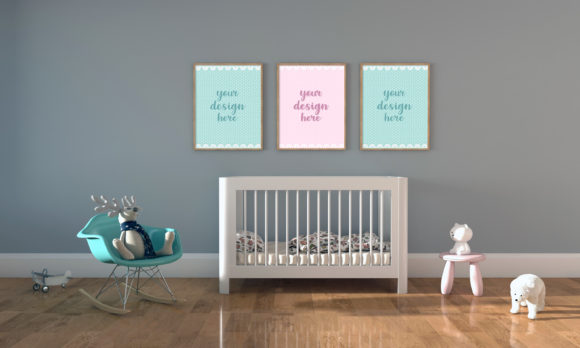
In the contemporary digital landscape, visual storytelling has become the primary currency for brands, artists, and creative professionals. Whether you are a shop owner showcasing a new line of nursery decor, an interior designer presenting a concept to a client, or a blogger curating a home improvement guide, the way you present your work dictates its perceived value. Static images often fail to capture the depth and atmosphere of a design. This is where A 3D Minimalist and Colorful Room Kids mockups emerge as a critical tool in the modern creator’s arsenal. By leveraging high-fidelity three-dimensional rendering, these assets allow for a seamless integration of custom designs into realistic, inviting environments.
The intersection of minimalism and vibrant color palettes creates a unique psychological appeal. Minimalism suggests clarity, organization, and modern elegance, while colorful elements evoke energy, creativity, and joy. When combined in a child-friendly context, this aesthetic becomes particularly powerful. It resonates with parents seeking safe, stimulating environments for their children and appeals to designers looking to demonstrate how bold choices can coexist with clean lines. Understanding how to utilize A 3D Minimalist and Colorful Room Kids effectively requires more than just knowing how to open a file; it involves grasping the underlying principles of spatial design, branding consistency, and user engagement.
The Psychology of Color and Space in Child-Centric Design
To truly appreciate the utility of this specific mockup style, one must first understand the environment it represents. Children’s spaces are not merely functional; they are developmental tools. The colors chosen for a room influence mood, focus, and emotional well-being. Bright, saturated hues can stimulate creativity and playfulness, while softer pastels or neutral bases provide a calming backdrop that reduces sensory overload. The minimalist approach ensures that the space does not feel cluttered, allowing the featured artwork or furniture to stand out without competing with background noise.
When using A 3D Minimalist and Colorful Room Kids, creators have the opportunity to test these psychological dynamics before committing to physical production. For instance, an artist might want to see how a bold, geometric print looks against a soft pastel wall. In a traditional photo shoot, this would require sourcing physical props, painting walls, and arranging lighting—a process fraught with potential errors. With a 3D mockup, the artist can overlay their design onto the virtual wall instantly. This allows for rapid iteration. If the contrast is too harsh, the color can be adjusted digitally. If the pattern feels lost, the scale can be modified. This flexibility empowers designers to refine their aesthetic decisions based on immediate visual feedback, ensuring that the final product aligns perfectly with the intended emotional response.
Bridging the Gap Between Concept and Reality
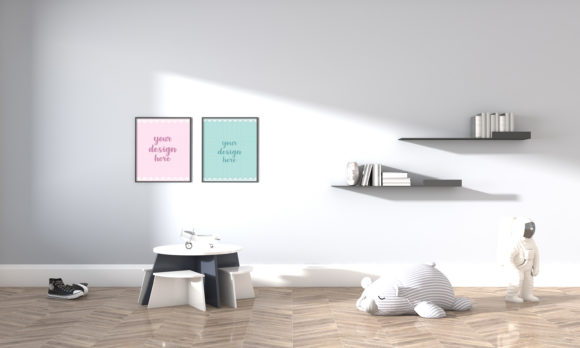
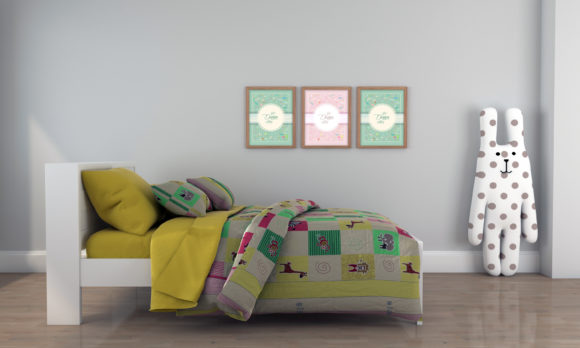
One of the most significant challenges in the creative industry is communicating abstract ideas to clients or customers. A sketch or a flat digital file lacks context. It is difficult for a non-designer to visualize how a piece of art will look in a real room, especially regarding scale, lighting, and shadow. A 3D Minimalist and Colorful Room Kids solves this problem by providing a photorealistic context. The 3D rendering includes accurate lighting effects, textures, and perspective, making the mockup indistinguishable from a photograph taken with a high-end camera.
This realism is crucial for branding. When a business presents its products within a cohesive, aesthetically pleasing environment, it signals professionalism and attention to detail. For example, a wallpaper company can use this mockup to display a variety of patterns. Instead of showing a roll of paper, they show the pattern applied to a wall, complete with baseboards, lighting fixtures, and perhaps a subtle hint of furniture. This contextualization helps the viewer imagine living with the product. It transforms the item from a commodity into an experience. The "minimalist" aspect of the room ensures that the focus remains on the customizable element—the artwork, frame, or wallpaper—without distraction.
Practical Applications for Diverse Professionals
The versatility of A 3D Minimalist and Colorful Room Kids extends across multiple industries. Its utility is not limited to just one type of user. Below are several key groups who benefit significantly from integrating this asset into their workflow.
- Shop Owners and E-commerce Entrepreneurs: Online retailers face the challenge of replacing the tactile experience of shopping. High-quality mockups bridge this gap. By displaying products in a realistic setting, store owners can increase conversion rates. A mockup allows for the creation of consistent product photography across an entire catalog, ensuring brand uniformity.
- Interior Designers and Decorators: These professionals need to present concepts clearly to clients. Using a 3D mockup allows them to propose different color schemes or art placements without physically redecorating. It serves as a powerful sales tool during consultations, helping clients visualize the end result.
- Graphic Artists and Printmakers: For those selling prints, posters, or digital downloads, presentation is everything. A beautiful piece of art can be diminished by poor presentation. Placing the artwork in A 3D Minimalist and Colorful Room Kids elevates its perceived value. It shows the customer exactly how the print will look framed and hung, reducing uncertainty and return rates.
- Bloggers and Content Creators: Visual content drives traffic. Bloggers writing about home decor, parenting, or DIY projects can use these mockups to create engaging headers, social media posts, and embedded images. Unique scenes make artwork look more outstanding, capturing the reader's attention in a crowded feed.
- Marketing Agencies: Agencies often need to produce marketing materials quickly. Time is money. Using pre-made, high-resolution mockups saves hours of setup time compared to creating scenes from scratch. This efficiency allows agencies to allocate more resources to strategy and copywriting.
Technical Workflow and Implementation
The effectiveness of any digital asset depends largely on its ease of use. A 3D Minimalist and Colorful Room Kids is designed with user convenience in mind, specifically targeting professionals who may not be 3D modeling experts but are proficient in standard graphic design software. The inclusion of a PSD (Photoshop) format is a strategic choice, as Adobe Photoshop remains the industry standard for image manipulation.
The workflow typically involves the following steps:
- Accessing the Smart Object: The PSD file contains layers organized logically. The core feature is the "Smart Object" layer. In Photoshop, double-clicking this layer opens a new window containing the flat template.
- Inserting Artwork: Users simply drag and drop their own design—whether it is a logo, a painting, a photo, or a pattern—into this window. Upon saving and closing the Smart Object window, the design automatically maps onto the wall in the 3D scene, adhering to the perspective and lighting of the room.
- Adjustments and Refinement: Because the layer is smart, users can resize, rotate, or apply filters to their design without degrading the quality of the original image. This non-destructive editing capability is essential for maintaining high standards.
- Exporting: Once satisfied, the file can be exported as a high-resolution JPEG. The provided dimensions of 5000 x 3000 pixels ensure that the output is sharp enough for large-format printing, such as banners or billboards, as well as crisp enough for retina displays on websites and social media platforms.
This process highlights the technical advantage of the mockup. It eliminates the need for complex 3D software knowledge like Blender or Maya. It democratizes high-end visualization, making it accessible to anyone with basic Photoshop skills. The high resolution ensures that when the final image is viewed, there are no pixelation artifacts, preserving the integrity of the brand’s image.
Strategic Advantages Over Traditional Photography
While professional photography is a valid method for product presentation, it comes with inherent limitations. Location scouting, set construction, lighting equipment, and post-production retouching all add up in cost and time. Furthermore, photography is static. If a client wants to see the same room with a different color scheme, a new photoshoot is required.
In contrast, A 3D Minimalist and Colorful Room Kids offers dynamic adaptability. You can reuse the same base image indefinitely. Need to showcase a winter collection? Change the lighting tone or overlay a seasonal pattern. Need to target a different demographic? Swap out the artwork. The ability to save time and money in the long term is a significant financial advantage. Over the course of a year, a single mockup purchase can replace dozens of small-scale photoshoots, offering a superior return on investment.
Additionally, the "unique scene" aspect mentioned in the product description is vital for SEO and brand differentiation. Stock photos are everywhere, and using generic backgrounds can make a brand blend into the competition. While the mockup provides a structure, the customization allows for infinite variations. By combining the consistent aesthetic of the minimalist room with diverse artistic overlays, businesses can build a distinctive visual identity that stands out in search results and social feeds.
Considerations for Best Results
To maximize the impact of using A 3D Minimalist and Colorful Room Kids, creators should adhere to a few best practices. First, always start with high-resolution source files for your artwork. Since the mockup itself is 5000 x 3000 pixels, low-resolution inputs will appear blurry when scaled up. Second, pay attention to the aspect ratio. Ensure your design fits the proportions of the wall space in the mockup to avoid awkward stretching or cropping. Third, consider the color theory. Since the room is colorful yet minimalist, choose artwork that complements or intentionally contrasts with the existing palette to create visual harmony. Finally, maintain consistency in your branding. If you are using this for a business, try to keep the framing or presentation style consistent across your marketing materials to reinforce brand recognition.
Conclusion
The evolution of digital marketing demands visuals that are not only attractive but also versatile and efficient. A 3D Minimalist and Colorful Room Kids represents a sophisticated solution to the common problems of presentation, cost, and time management. By merging the aesthetic appeal of modern, colorful interiors with the practical functionality of smart object technology, it empowers a wide range of professionals to elevate their work. Whether you are advertising a new design, showcasing your portfolio, or enhancing your blog’s visual appeal, this tool provides the foundation for outstanding visual communication. It allows creators to focus on their craft, knowing that the presentation will do justice to their efforts.